Supplements · Triathlon · Endurance Sports · Nutrition · Training
Beta-Alanine, Citrulline Malate & Creatine: The 3 Underrated Supplements for Endurance Sports & Triathlon
September 21, 2026
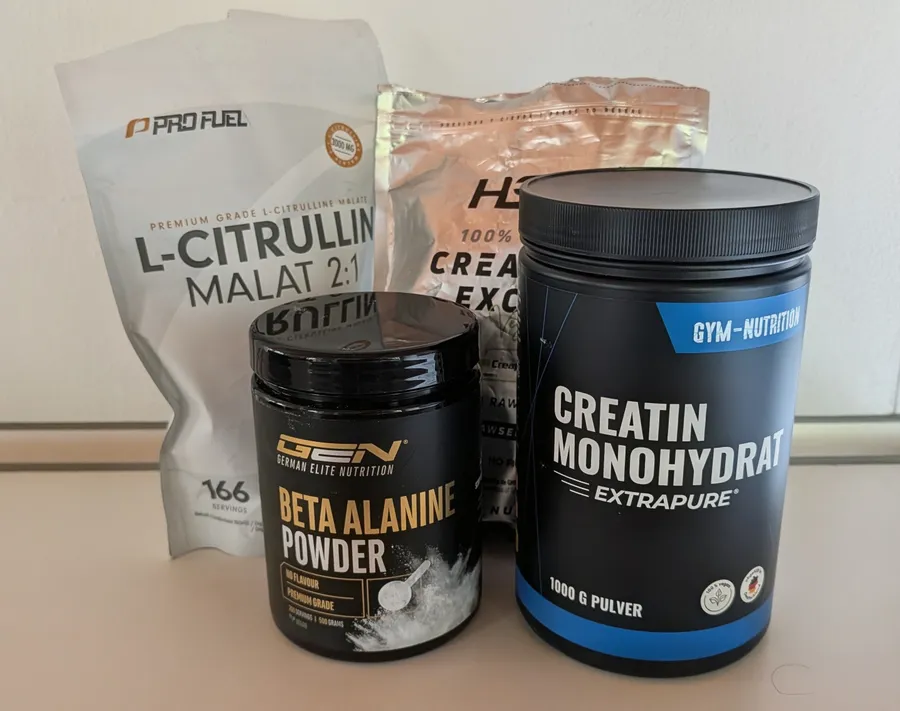
When supplements come up in endurance sports, the conversation almost always centers on the same three classics: carbohydrates, caffeine and electrolytes in the form of gels, bars or powder taken during exercise. Rightly so – these products are well researched, well established, and a fixed part of many athletes’ race and training strategy.
That’s exactly why this article deliberately leaves them out. Instead, it focuses on three supplements that, in my experience, are significantly underrated in the triathlon and endurance community, despite solid research behind them: beta-alanine, citrulline malate and creatine. All three don’t primarily work during competition itself, but rather where real performance development actually happens – in hard training.
1. Beta-Alanine: Less Acidosis, Holding High Intensity Longer
Beta-alanine is a non-essential amino acid that increases carnosine levels in skeletal muscle. Carnosine acts as an intramuscular buffer against hydrogen ions that accumulate during high-intensity exercise and cause muscular acidosis (a drop in pH).
Practical effect: The dreaded “muscle burn” during hard track intervals, VO2max sessions, or steep climbs on the bike is delayed. Athletes can hold target power or pace longer before acidosis becomes the limiting factor.
A meta-analysis by Hobson et al. (2012) covering 15 studies found a significant effect of beta-alanine on performance in exercise lasting between 1 and 4 minutes – exactly the range where many high-intensity endurance sessions take place. The International Society of Sports Nutrition (Trexler et al., 2015) classifies beta-alanine as safe and effective for improving training capacity during high-intensity exercise.
2. Citrulline Malate: Better Blood Flow, More Efficient Clearance
Citrulline malate is converted in the body to arginine, subsequently boosting nitric oxide (NO) production. Nitric oxide dilates blood vessels (vasodilation), improving blood flow to working muscles.
Practical effect: Better blood flow means more oxygen and nutrient delivery to the muscles, as well as more efficient clearance of metabolic byproducts like lactate and ammonia. This supports both overall endurance performance and recovery between intensity spikes.
Pérez-Guisado and Jakobsen (2010) showed in a placebo-controlled study a significant reduction in muscle soreness as well as an increased number of repetitions under load after citrulline malate supplementation. Further reviews (Trexler et al., 2019) confirm positive effects on endurance-related performance parameters, particularly during repeated high-intensity efforts.
3. Creatine: Not Just for Strength Athletes
Creatine is almost reflexively associated with strength sports – wrongly so when it comes to endurance sport. Creatine increases intramuscular phosphocreatine stores, the fastest available energy source for ATP resynthesis.
Practical effect for triathletes and runners:
- Explosive power spikes: During attacks, on climbs, or in a decisive finish sprint, muscles directly benefit from faster available energy.
- Faster recovery: Creatine supports the replenishment of energy stores between intense training sessions and can accelerate structural muscle recovery – relevant given the high weekly training volumes in triathlon.
- Beyond sport: Emerging research increasingly shows effects of creatine on brain health, including cognitive performance under sleep deprivation or stress – a factor that can be quite relevant for athletes juggling high training loads and daily life stress.
The International Society of Sports Nutrition position stand (Kreider et al., 2017) confirms creatine monohydrate as one of the most researched and safest supplements available. Reviews on its cognitive and neuroprotective effects (Forbes et al., 2022; Rawson & Venezia, 2011) highlight additional benefits beyond pure athletic performance.
Race Day or Training – Where Do These Supplements Actually Matter?
This is the most important message of this article: none of these three supplements are necessarily a decisive advantage on race day – especially not for longer distances like middle- or long-distance triathlon, where intensity is so low that hardly any relevant lactate accumulates and muscular acidosis isn’t a limiting factor.
Their real value shows up in training – particularly with a polarized training approach, where a few, but very high-intensity sessions are deliberately built into the training plan:
| Supplement | Mechanism | Biggest Benefit |
|---|---|---|
| Beta-Alanine | Buffers muscular acidosis | Holding high intensity longer during intervals |
| Citrulline Malate | Improves blood flow & clearance | Better quality during repeated intensity spikes |
| Creatine | Faster ATP availability | Explosive power & faster recovery between sessions |
Athletes who can execute these key high-intensity sessions with more power and quality improve, long-term, exactly the physiological adaptations (e.g. VO2max, lactate threshold) that make the decisive difference on race day – even if the supplement itself is no longer front and center on race day.
Practical Guide: When and How Much?
| Supplement | Dosage | Timing | Key Detail |
|---|---|---|---|
| Beta-Alanine | 3.2–6.4 g/day, split into several smaller doses (e.g. 4 x 0.8–1.6 g) | Daily, independent of training, spread throughout the day | Must be taken consistently for 4–6 weeks to sufficiently build up muscle carnosine stores. Skin tingling (paresthesia) is harmless and can be reduced by splitting the dose. |
| Citrulline Malate | 6–8 g, single dose | About 45–60 minutes before the intense session | Works acutely, no need for continuous use – a single dose before the relevant key session is sufficient. |
| Creatine | Maintenance: 3–5 g/day, ongoing (alternatively a loading phase: 20 g/day over 5–7 days, split into 4 doses) | Daily, timing is secondary (e.g. with a meal) | Without a loading phase, it takes 3–4 weeks for creatine stores to fully saturate. Consistent daily intake matters far more than timing it around a specific workout. |
Since both beta-alanine and creatine rely on fully saturated stores in the body, it’s worth starting several weeks before a planned high-intensity training block or race phase – starting too late means giving up much of the benefit. Citrulline malate, on the other hand, can be used flexibly and specifically before individual key sessions.
Conclusion
Beta-alanine, citrulline malate and creatine aren’t race-day supplements in the classic sense, like carbohydrate gels or caffeine. Their value lies in increasing the quality of the hard training sessions that drive actual performance development. If you take your high-intensity training sessions seriously, these three supplements deserve a lot more credit than they usually get.
Sources
- Hobson, R. M. et al. (2012). Effects of β-alanine supplementation on exercise performance: a meta-analysis. Amino Acids, 43(1), 25–37.
- Trexler, E. T. et al. (2015). International society of sports nutrition position stand: Beta-Alanine. Journal of the International Society of Sports Nutrition, 12, 30.
- Pérez-Guisado, J., & Jakobsen Jakobsen, P. (2010). Citrulline malate enhances athletic anaerobic performance and relieves muscle soreness. Journal of Strength and Conditioning Research, 24(5), 1215–1222.
- Trexler, E. T. et al. (2019). Effects of Citrulline Malate supplementation on exercise performance in trained and untrained individuals. Journal of Sports Science, 37(21), 2404–2413.
- Kreider, R. B. et al. (2017). International Society of Sports Nutrition position stand: safety and efficacy of creatine supplementation in exercise, sport, and medicine. Journal of the International Society of Sports Nutrition, 14, 18.
- Rawson, E. S., & Venezia, A. C. (2011). Use of creatine in the elderly and evidence for effects on cognitive function in young and old. Amino Acids, 40(5), 1349–1362.
- Forbes, S. C. et al. (2022). Effects of creatine supplementation on brain function and health. Nutrients, 14(5), 921.
Note: This article is for general information purposes only and does not replace individual nutritional counseling. Supplement use should be discussed with a doctor or nutrition professional, especially in the presence of pre-existing conditions or medication use.
Still have questions about this?